


How to attach teether clips to baby outfits safely
Teether clips seem simple enough until you realize that the wrong attachment can turn a helpful tool into a genuine hazard. Many parents discover this the hard way, reaching for a cute clip-on teether only to wonder whether it’s actually safe or just convenient. The good news is that safe teether attachment is straightforward once you know the rules. This guide walks you through the risks, the right products to choose, and the exact steps to attach any teether clip securely to your baby boy’s outfit without compromising his safety or comfort.
Table of Contents
- Understanding teether clip risks and essential safety guidelines
- What you need: Choosing the safest teether and clip attachments
- Step-by-step: How to attach a teether clip to your baby’s outfit safely
- Common mistakes to avoid and how to check for safe attachment
- Why expert-backed safety practices matter more than trends
- Explore tested solutions for teething and mobility
- Frequently asked questions
Key Takeaways
| Point | Details |
|---|---|
| Prioritize safety features | Choose teether clips with secure attachments, no small parts, and confirmation of safety certifications. |
| Avoid dangerous accessories | Never use teething necklaces or ties around the neck, as these increase choking and strangulation risks. |
| Attach properly every time | Always clip teethers to flat parts of clothing away from the neck and inspect for loose parts before every use. |
| Monitor babies during use | Supervise your baby when a teether is attached and remove it during sleep or naps. |
Understanding teether clip risks and essential safety guidelines
To make smart decisions, it’s important to first understand what can go wrong with improper attachment. Teether clips can be incredibly practical, but they carry real risks when used incorrectly. The most serious dangers are strangulation and choking, both of which can happen faster than any parent expects.
The American Academy of Pediatrics (AAP) is clear on this point. Teething necklaces pose serious risks for choking and strangulation, and no pediatric organization endorses them. Yet they remain popular because they look stylish and seem harmless. That gap between appearance and reality is exactly where accidents happen.
Here are the non-negotiable safety rules every parent should follow before attaching any teething accessory to their baby:
- Never tie a teether or clip around your baby’s neck, wrist, or ankle. Loops of any kind near a baby’s body create strangulation risk.
- Never attach a teether clip to a crib, stroller strap, or car seat harness. These positions can trap or wrap around a baby during movement or sleep.
- Never leave your baby unsupervised with any clip-on teether. Active supervision is the single most effective safety measure.
- Avoid teething necklaces and jewelry-style accessories entirely. These are not clip-on teethers. They are a separate and consistently flagged category of risk.
- Remove all teething accessories before naps and bedtime. Sleep time is not supervised time.
“Clip-on pacifier and teether accessories should never be tied around the neck or used in a way that creates a strangulation risk.” — American Academy of Pediatrics
Understanding these boundaries gives you a solid foundation. From here, every decision you make about teether selection and attachment becomes much clearer. You can find more teething safety tips that cover the full picture of what works and what to skip entirely.
What you need: Choosing the safest teether and clip attachments
Now that you know what to avoid, let’s see what makes a teether clip both safe and effective. Not all clips are created equal, and the difference between a safe product and a risky one often comes down to a few specific design features.
When you’re shopping for a clip-on teether, prioritize these features above everything else:
- No sharp edges anywhere on the clip or chewable portion. Babies explore with their mouths and hands, and sharp edges cause cuts and irritation.
- No detachable parts. Any piece that can come loose is a choking hazard. This includes decorative beads, small rings, or removable chew attachments.
- A secure, functional clip mechanism. The clip should grip fabric firmly without pinching, and it should not release under normal baby pulling force.
- Food-grade silicone or organic cotton for the chewable portion. These materials are BPA-free, non-toxic, and safe for prolonged chewing.
- Age-appropriate ratings. Look for products specifically designed for babies aged 3 to 12 months, which is the peak teething window.
- U.S. safety standard compliance. Products meeting ASTM or CPSC standards have been tested for infant use.
The AAP specifically flags teething necklaces as unsafe for infants, making clip-on options the only responsible choice for wearable teething accessories. The distinction matters because necklaces are worn around the neck, while clip-on teethers attach to clothing and hang within reach of baby’s hands.
Here’s a quick comparison of key safety features to look for when evaluating any clip-on teether:
| Feature | Safe option | Unsafe option |
|---|---|---|
| Edges | Smooth, rounded | Sharp or unfinished |
| Parts | Fixed, no detachable pieces | Beads, rings, or removable parts |
| Clip strength | Holds under baby pulling | Releases easily or too stiff |
| Material | Food-grade silicone, organic cotton | Unknown plastics, painted surfaces |
| Age rating | 3 to 12 months | Unspecified or adult-oriented |
| Safety standard | ASTM/CPSC compliant | No certification listed |
Well-designed clip-on teethers, like those with no sharp edges and no detachable parts, meet U.S. safety standards and give parents a reliable baseline to work from. Some clip-on teething accessories are recommended for babies as young as 3 months, are made of food-grade silicone, and have no small parts or choking hazards, which makes them suitable for the entire early teething window.
Pro Tip: Before purchasing any clip-on teether, check the product listing for explicit mentions of ASTM compliance, BPA-free materials, and age range. If those details are missing, treat it as a red flag and keep looking.
The TastyTie teething tie with safe clip is one example of a product that hits all of these marks. It’s made from organic cotton, clips securely to clothing, and is designed specifically for baby boys aged 3 to 12 months. For parents who want a complete outfit solution, the teether bodysuit bundle pairs a safe teether with a coordinated look, making it easy to dress your baby and have his teether ready to go.
Step-by-step: How to attach a teether clip to your baby’s outfit safely
With a safe, quality clip in hand, here’s exactly how to attach it to your baby’s outfit. Following these steps consistently turns a simple action into a reliable safety habit.
-
Choose the right attachment point on the outfit. The chest area or a collar seam works best. Look for a sturdy, flat section of fabric that won’t bunch or stretch under the clip’s grip. Avoid thin or delicate fabric sections that might tear.
-
Test the clip before attaching it to your baby. Open and close the clip several times with your fingers to confirm it functions smoothly. Check that it grips firmly when closed. If it feels loose or stiff, do not use it.
-
Attach the clip to the fabric with the teether hanging downward. The chewable portion should hang at chest level, well within your baby’s reach but nowhere near his face or neck when he’s not actively holding it.
-
Check that the fabric lies flat under the clip. No bunching, no folding. The clip should sit flush against the outfit without creating any gathered fabric that could shift during movement.
-
Tug gently on the clip after attaching it. Apply the kind of pulling force your baby might use. The clip should stay in place. If it releases easily, reattach it to a sturdier section of fabric or reconsider the product.
-
Confirm there is no loop or dangling cord. The attachment between the clip and the teether should be short and fixed. A long cord or loop near your baby’s neck area is a strangulation risk, full stop.
-
Monitor your baby throughout the entire time the teether is clipped on. Supervision is not optional. Babies shift, roll, and move in unpredictable ways, and what’s safe in one position may not be safe in another.
-
Remove the teether clip before naps and bedtime. This is a firm rule with no exceptions. Sleep time requires a clear, accessory-free environment.
Some clip-on teething accessories are intended to clip securely with no small parts or choking hazards, which makes the attachment process more straightforward. Products designed with safety as a core feature, not an afterthought, make each of these steps easier to execute consistently.
Pro Tip: Keep the teether clipped at chest level rather than shoulder level. Chest-level placement gives your baby easy access to chew while keeping the accessory away from his face and neck during natural movement.
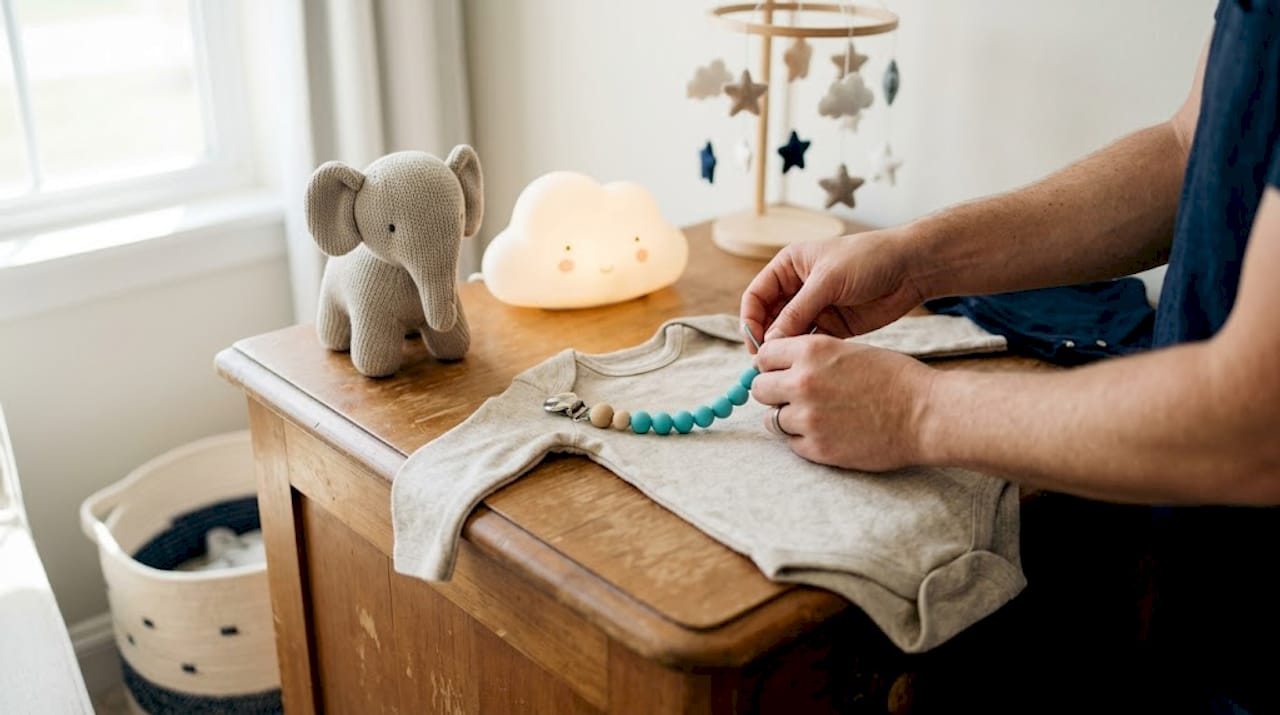
For parents who want to simplify the whole process, an organic cotton bodysuit with a structured collar gives you a reliable attachment point every single time. No guessing about fabric strength or placement.
Common mistakes to avoid and how to check for safe attachment
Even with the right tools, mistakes happen. Here’s what to look out for and how to check every attachment before and after use.
The most common errors parents make with teether clips fall into a few predictable patterns. Recognizing them ahead of time helps you avoid them entirely.
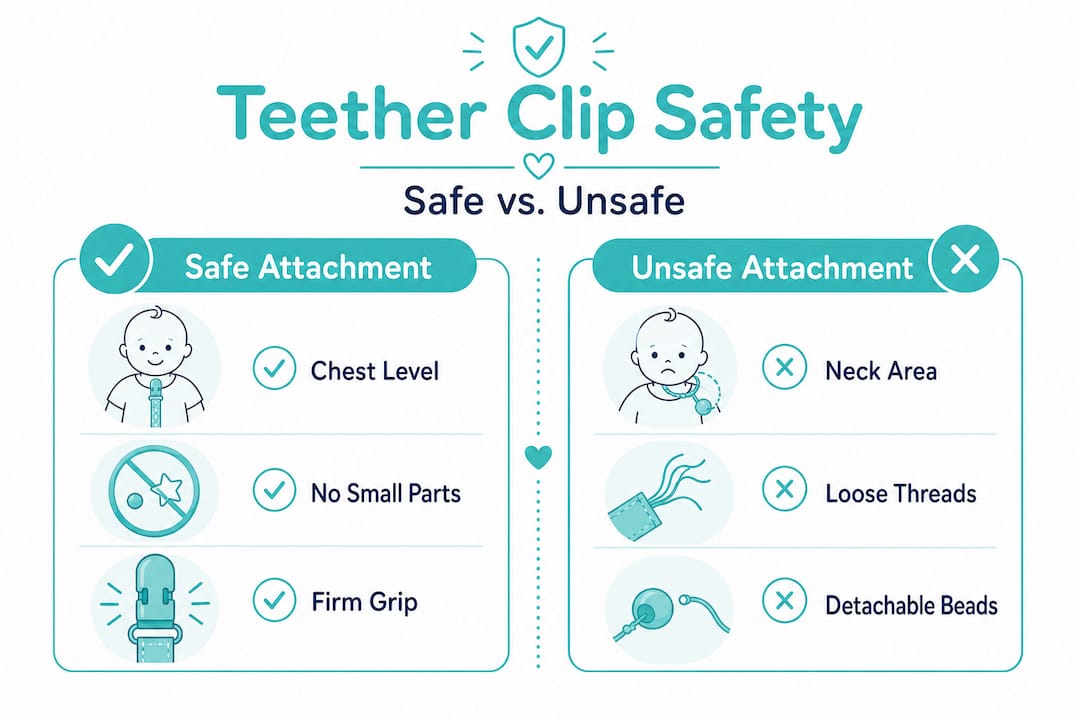
| Common mistake | What goes wrong | Correct approach |
|---|---|---|
| Attaching near the collar or neck | Creates strangulation risk if baby turns or rolls | Clip to chest seam, well below the neck |
| Using a worn or damaged clip | Clip may release unexpectedly | Inspect before every use, replace if worn |
| Leaving the teether on during sleep | No supervision means no safety net | Always remove before naps and bedtime |
| Attaching to thin or stretchy fabric | Fabric may tear or shift, releasing the clip | Use sturdy, flat fabric sections only |
| Allowing the cord to loop | Loops near baby’s body are a strangulation hazard | Choose fixed, short attachments only |
Here’s a quick checklist to run through every time you attach a teether clip:
- Is the clip attached to a flat, sturdy section of the outfit?
- Does the clip sit flush without bunching the fabric?
- Is the teether hanging at chest level, not near the neck?
- Is there any loop or cord that could wrap around your baby?
- Did you tug-test the clip after attaching it?
- Is your baby going to be actively supervised while wearing it?
The AAP guidance is unambiguous: accessories should never be tied around the neck or used in a way that creates a strangulation risk. That principle extends to any clip-on accessory that creates loops, long cords, or attachment points near a baby’s face or neck.
Pro Tip: Do a quick visual check every 15 to 20 minutes while your baby is wearing a teether clip. Babies move constantly, and a clip that was perfectly positioned at the start of playtime may have shifted. A fast glance is all it takes to catch a problem early.
You can read through teether safety reviews from real parents to see how others handle these checks in everyday situations. Real-world experience from other caregivers adds useful context that product descriptions alone can’t provide.
Why expert-backed safety practices matter more than trends
After seeing how to do it safely, it’s worth considering why taking these steps matters, even if popular options seem easier or more stylish. In my opinion, this is the part of the conversation that gets skipped too often.
Trendy teething accessories cycle through parenting communities quickly. Amber necklaces, beaded teething jewelry, and decorative clip-on accessories with long cords have all had their moments. They look charming in photos. Other parents seem to use them without incident. It’s easy to assume that widespread use means something is safe.
But pediatric safety guidance doesn’t move with trends. The AAP recommends that if your baby self-soothes by chewing, you should prioritize fixed, chewable teether components designed for infants rather than jewelry-like teething necklaces. That recommendation exists because the risks are real, even when outcomes are rare.
Rare does not mean impossible. Strangulation and choking incidents involving infant accessories are documented in pediatric safety literature and product recall databases. The fact that most parents never experience these outcomes is partly luck and partly supervision. Removing the luck factor by choosing safe, well-designed products is something every parent can do.
There’s also a practical upside that gets overlooked. When you choose a clip-on teether designed with genuine safety features, like an award-winning teether clip built from organic cotton with no detachable parts, your baby benefits in more ways than one. He gets a tool that supports self-soothing and independent play. You get peace of mind that doesn’t require constant anxiety. That combination, comfort for him and confidence for you, is what thoughtful product design actually delivers.
Trends will keep coming. The guidance from pediatric experts will stay consistent. Choosing the latter over the former is always the right call.
Explore tested solutions for teething and mobility
Equipped with safe attachment practices, you can discover solutions that combine peace of mind and practical style.

TastyTie’s teething tie with secure clip is designed from the ground up to meet every safety standard covered in this guide. It clips directly to your baby boy’s outfit at chest level, is made from soft organic cotton, absorbs drool, and entertains with a gentle crinkle sound that babies love. No cords. No detachable parts. No guessing about attachment safety. If you want a complete look that’s ready to go from the moment you dress your little one, the teether and outfit bundle pairs a structured bodysuit with the teether for a polished, practical combination. Still on the fence? Browse real parent reviews to see how thousands of families use TastyTie every day.
Frequently asked questions
Are teether clips safe for babies to use unsupervised?
No, babies should always be supervised when using teether clips to prevent accidental choking or strangulation. The AAP advises that clip-on accessories should never be used in a way that creates a strangulation risk, which requires active adult oversight at all times.
What is the safest way to attach a teether to my baby’s clothing?
Attach the teether clip to a flat, sturdy section of clothing at chest level and never near the neck or in a way that creates a loop. The AAP specifically warns against tying any accessory around a child’s neck, crib, or hand.
Are teething necklaces safe for infants?
No, pediatricians are clear that teething necklaces pose serious risks for choking and strangulation and should be avoided entirely. Clip-on teethers that attach to clothing are the safe alternative.
How do I know if a teether clip is high quality?
Look for U.S. safety standard compliance, no sharp edges and no detachable parts, and an age rating starting at three months. Products recommended for babies 3 to 18 months with no small parts and no choking hazards meet the baseline criteria for safe use.

