


Why babies reject silicone teethers and what to do
TL;DR:
- Teether rejection is common in infants aged 3 to 12 months and is usually due to biological reflexes, sensory preferences, or teething discomfort. Babies often gag due to the tongue-thrust reflex early on and may refuse teethers if textures, shapes, or firmness do not match their sensitivities, especially during gum inflammation. Patience, proper safety considerations, and matching teether design to developmental stages help support comfortable teething experiences.
You spend time reading reviews, pick a top-rated silicone teether, and hand it to your baby with confidence. Then he gags, spits it out, and looks at you like you’ve personally offended him. It’s confusing, maybe a little alarming, and definitely frustrating. But here’s the reassuring truth: teether rejection is incredibly common, especially in the 3 to 12 month window, and it’s almost never about stubbornness. More often, it’s biology, sensory preference, design mismatch, or the teething process itself. This guide explains exactly what’s happening and what you can do about it.
Table of Contents
- The natural reflexes behind teether rejection
- Sensory preferences and the oral-motor mismatch
- Why teether design matters: Safety and fit
- Teething pain, timing, and temporary refusals
- What to do: Matching teether to baby’s needs
- What most “baby teether” advice gets wrong
- Gentle, safe, and smart: Solutions for happy teething
- Frequently asked questions
Key Takeaways
| Point | Details |
|---|---|
| Gag reflex is normal | Many babies reject teethers at first due to a natural tongue-thrust reflex that fades over time. |
| Sensory preferences vary | Babies have unique likes and dislikes in shapes, textures, and firmness, so a one-size-fits-all teether rarely works. |
| Design and safety matter | Select teethers that fit your baby’s age and stage—avoid bulky designs or those flagged by safety recalls. |
| Pain changes preferences | Teething discomfort may cause your baby to temporarily reject their favorite item, so offer gentle alternatives. |
| Stage-matched approaches win | Introduce teethers gradually, support self-holding, and seek help for persistent or extreme refusal. |
The natural reflexes behind teether rejection
When your baby gags on a teether right away, your first instinct might be to assume the product is a bad fit or that something is wrong. In reality, the culprit is often something entirely healthy: the tongue-thrust reflex, also called the extrusion reflex.
This reflex causes babies to push objects out of their mouths using their tongue. It’s a protective mechanism that prevents choking during the early months when babies are not yet ready to manage solid objects orally. Teething items can trigger gagging simply because this reflex is still very much active.
Here’s the key information parents need to understand about this reflex:
- It’s strongest in the first 4 months. Babies under 4 months will almost always push objects out of their mouths reflexively.
- It starts to diminish around 4 to 6 months, though the timeline varies from baby to baby.
- Rejection now does not mean rejection forever. Many babies who gag at 3 months accept teethers easily by 5 or 6 months.
- The reflex is not an indicator of oral sensitivity disorders on its own; it’s a developmental milestone, not a problem.
“The extrusion reflex is your baby’s built-in safety system. It’s doing exactly what it was designed to do. Give it time, and your baby’s readiness will catch up.”
One simple strategy is to explore self-soothing teething tips that work within this developmental window rather than fighting it. Patience and timing are genuinely your best tools here.
Sensory preferences and the oral-motor mismatch
Once the extrusion reflex fades, you might expect your baby to happily accept any teether you offer. Some babies do. But many don’t, and the reason is just as interesting: sensory preference.
Babies are individuals from the very beginning. Just as adults have opinions about food textures, babies have strong (if wordless) opinions about what feels acceptable in their mouths. An oral-motor mismatch happens when a teether’s texture, firmness, or shape simply doesn’t match what a baby finds tolerable, especially when their gums are sore and extra sensitive.
Common sensory factors that influence acceptance include:
- Texture. Some babies dislike the slick surface of smooth silicone. Others find ridged or bumpy textures overstimulating.
- Firmness. Hard silicone can feel uncomfortable on inflamed gums. Softer options may be better tolerated during active teething flares.
- Temperature. Many babies respond much better to chilled teethers, especially if gum inflammation is high.
- Shape. Some shapes reach too far back, trigger the gag reflex, or are simply awkward to hold against sore spots.
- Fabric and organic materials. Babies who reject all silicone sometimes accept soft cotton or textured fabric willingly.
Pro Tip: If your baby refuses all firm silicone options, try offering a clean damp washcloth that’s been chilled in the refrigerator. It gives pressure and cold relief without triggering sensory rejection. Once he’s used to the sensation, introduce a teether for sensitive gums alongside the familiar fabric.
The takeaway is that “universal” teether products don’t really exist. What works beautifully for one baby may be deeply unpopular with another, and that’s completely normal.
Why teether design matters: Safety and fit
Beyond sensory preferences, it’s worth looking closely at the actual design of any teether you introduce. Not every product on the market is designed with your baby’s oral-motor stage in mind, and some designs actively increase the risk of gagging or rejection.
Here’s a quick look at how design features stack up against common issues:
| Design feature | Risk or benefit |
|---|---|
| One-piece solid construction | Lower choking risk, easier to clean |
| Multiple small parts or pull strings | Higher choking risk; some have been recalled |
| Deep insertion shape | Can trigger gag reflex, especially in younger babies |
| Clip-on attachment | Stays accessible, won’t drop, reduces floor contact |
| Organic cotton + silicone combo | Offers texture variety, gentler on sensitive gums |
| Oversized novelty shapes | May look fun but can be awkward or unsafe for mouthing |
The safety concern is real. Some silicone teethers have been recalled by the U.S. Consumer Product Safety Commission due to choking risks, reminding parents that “popular” or “trending” does not automatically mean safe or age-appropriate.
Stat callout: The CPSC issues product safety recalls regularly, and baby products, including teethers and teething toys, represent a significant portion of recalled items each year. Always verify product safety before purchasing.
Pro Tip: Look for teethers with smart design that are one-piece, BPA-free, and designed for the 3 to 12 month age range specifically. Check for safe teether attachment methods too, since a teether that clips securely to clothing is far less likely to become a drop-and-gag hazard.
Teething pain, timing, and temporary refusals
Here’s something that surprises many parents: sometimes the teething process itself is why your baby rejects a teether. It sounds counterintuitive, but it makes sense once you understand what’s happening in those little gums.
Teething can make babies less willing to chew because applying pressure to already sore, inflamed gum tissue can be genuinely uncomfortable, even painful. A teether that your baby loved last week might be refused this week simply because a new tooth is pushing through in a sensitive spot.
Here’s a practical sequence to try when your baby is in an active teething flare and refusing his usual teether:
- Start with gum massage. Use a clean finger to gently rub the affected gum. This provides relief without the pressure of a firm object.
- Offer a chilled (not frozen) teether. Cold reduces inflammation. A frozen teether can actually damage delicate gum tissue.
- Try a fabric-based option. Soft materials like organic cotton are often more welcome during acute pain flares.
- Return to the silicone teether after the acute phase passes. Most babies cycle back to preferred teethers once the worst of a flare calms down.
- Match the teether to the location of discomfort. Front gum pain and back molar pain require different shapes.
| Teething stage | Common preference | What to try |
|---|---|---|
| Early (3 to 5 months) | Soft fabric, chilled items | Organic cotton, damp washcloth |
| Mid (5 to 8 months) | Silicone + fabric combo | Clip-on, multi-texture designs |
| Late (8 to 12 months) | Firmer teethers for back gums | Denser silicone, ring shapes |
What to do: Matching teether to baby’s needs
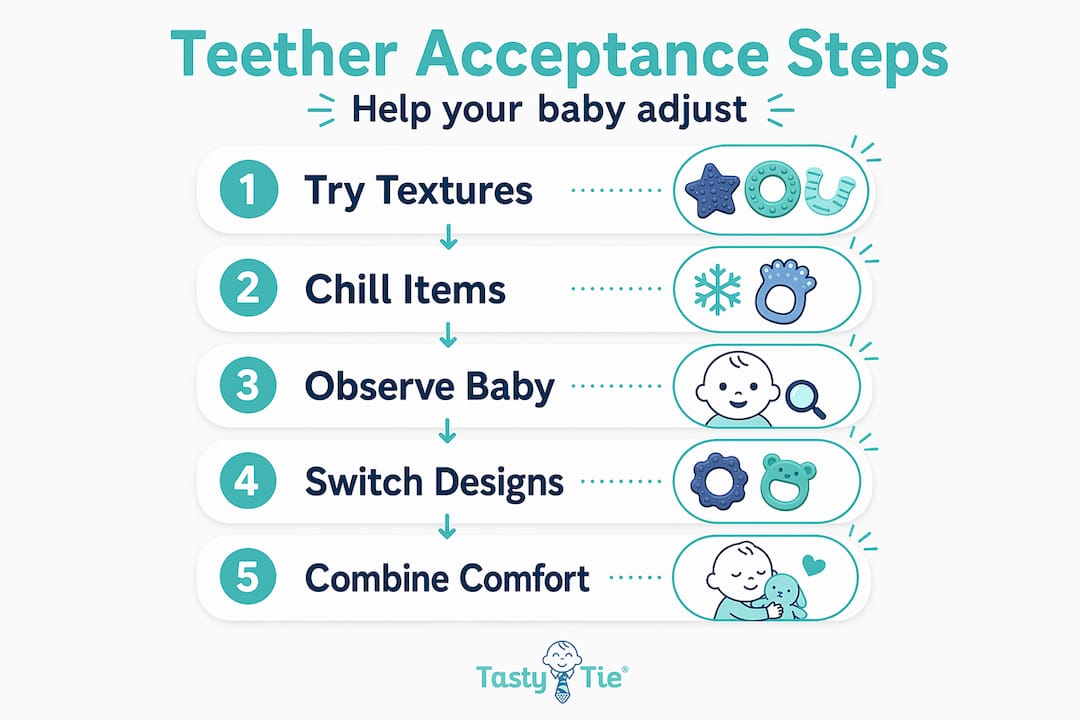
With all of this context in place, the solution becomes clearer. The goal isn’t to find the one perfect teether; it’s to match the baby’s stage and adjust as he develops. Simple, solid, one-piece designs are the safest starting point, and gradual introduction gives your baby time to adjust to new sensations.
Here’s what an effective teether introduction strategy looks like:
- Start simple. One-piece silicone or organic cotton. No small parts, no deep insertion shapes.
- Introduce gradually. Let your baby mouth the teether for short sessions rather than relying on it for extended soothing from day one.
- Pay close attention to feedback. Consistent gagging on many textures across several weeks is different from occasional refusal.
- Encourage self-holding. Babies who hold their own teethers develop hand-to-mouth coordination and early independence. Always supervise, but let him lead.
- Know when to ask for help. If gagging is frequent and persistent across textures, it may point to oral sensory or oromotor issues that a feeding therapist or pediatrician can evaluate. This is rare, but worth knowing.
The bundle for teething comfort approach, combining soft apparel with an accessible teether, works especially well for babies who need a sensory bridge between familiar comfort and new objects.
What most “baby teether” advice gets wrong
Most articles about teether refusal focus on switching products. Try this brand. Try that texture. Buy the next thing. In my opinion, that misses the bigger picture entirely.
The real issue isn’t the teether. It’s the mismatch between what the product offers and where your baby is developmentally right now. Every rejection is information. It’s your baby communicating his readiness, his preferences, and his needs without words. Treating it as a product problem leads to a drawer full of rejected teethers and a frustrated parent.
Teether play supports self-soothing and oral motor development in ways that go well beyond gum relief. When babies practice holding, mouthing, and exploring teethers independently, they’re building the coordination and self-regulation skills they’ll rely on for years. Rushing that process with the “best-rated” product often undermines it.
The better strategy is to slow down, observe your baby, and offer real-life teething solutions that meet him where he is. Incremental acceptance is genuine progress, even if it doesn’t look like success right away.
Gentle, safe, and smart: Solutions for happy teething
If you’ve been working through teether rejection and you’re ready to try something genuinely different, we’d love to introduce you to TastyTie. Our award-winning teether tie was designed specifically for baby boys aged 3 to 12 months, combining organic cotton, BPA-free silicone, a satisfying crinkle sound, and a clip-on design that stays right where your baby needs it. No more dropped teethers. No more floor searches. Just safe, independent chewing and self-soothing that travels with your little one everywhere. Explore our bodysuit and teether bundle to see why over 35,000 families have made TastyTie part of their teething routine.
Frequently asked questions
Is it normal for babies to gag on teethers?
Yes, gagging is very common, especially in younger babies. The tongue-thrust reflex is a protective mechanism that naturally causes babies to push objects from their mouths, and it typically diminishes between 4 and 6 months.
What should I do if my baby refuses all teethers?
Try a variety of textures and temperatures, and introduce each one slowly over several days. If the refusal is persistent and severe across many different options, it’s worth checking in with your pediatrician or a feeding specialist.
Are all silicone teethers safe?
No, not all silicone teethers are equally safe. Some have been recalled for choking risks, so always verify safety certifications and check CPSC recall listings before buying.
Can teething pain itself cause teether rejection?
Absolutely. Teething can make babies avoid chewing because pressure on sore gums is uncomfortable. During intense flares, chilled items or gum massage are often better tolerated than firm teethers.
How can I tell if my baby is ready for silicone teethers?
Look for mouthing interest, reduced gagging response, and the ability to grip objects. Start with simple, solid silicone designs and introduce them in short, supervised sessions to build comfort gradually.

