


Crinkle Sound Toys and Infant Brain Development
TL;DR:
- Crinkle sound toys stimulate infant brain development by providing consistent auditory and tactile feedback that strengthen neural pathways. They promote cause-and-effect learning, fine motor skills, and sensory integration through multi-sensory engagement involving touch, sight, and sound. Properly chosen and used, these toys support early communication, attention, and motor development in babies.
Crinkle sound toys are sensory tools that stimulate infant brain development by delivering predictable auditory and tactile feedback that newborn neural pathways are biologically primed to process. Known in developmental research as “contingent auditory stimuli,” these toys produce a consistent sound every time a baby touches, squeezes, or grabs them. That cause-and-effect loop is not just entertaining. It actively strengthens the neural circuits responsible for attention, early speech perception, and sensory integration. Research confirms that auditory stimulation drives sensory system maturation in infants, meaning the sounds your baby hears in the first months of life are literally building their brain.
How do crinkle sound toys stimulate infant brain development?
The neurological case for crinkle sound toys starts at birth. A landmark EEG study found that newborns detect coherent sounds in noisy environments by processing temporal coherence, the brain’s ability to recognize that a sound is consistent and predictable. This capacity is foundational for both selective attention and early speech perception. When a crinkle toy produces the same soft, rustling sound every time a baby squeezes it, the infant brain registers that pattern and begins building the neural architecture to respond to it intentionally.
Separate neonatal fNIRS research shows that newborn brains respond more strongly to salient, structured sounds like speech and song than to flat, monotone inputs. Crinkle sounds fall into this category of salient stimuli. They are distinct, repeatable, and responsive to the baby’s own movement, which makes them far more neurologically engaging than ambient background noise or passive electronic sounds.
Here is what that means practically for your baby’s development:
- Auditory stream segregation: The infant brain learns to isolate the crinkle sound from surrounding noise, a skill that directly supports later language processing.
- Cause-and-effect learning: Every squeeze that produces a sound teaches the baby that their actions have consequences, which is one of the earliest forms of cognitive reasoning.
- Selective attention: Repeated exposure to a consistent sound trains the brain to focus, a skill that underpins reading, listening, and learning throughout childhood.
- Neural circuit strengthening: The more a baby hears and responds to a predictable sound, the more efficiently those neural pathways fire, a process neuroscientists call synaptic pruning and reinforcement.
Pro Tip: Place a crinkle toy in your baby’s hand during tummy time. The combination of physical effort and auditory reward creates a richer learning moment than either activity alone.
What are the multi-sensory benefits of crinkle toys for babies?
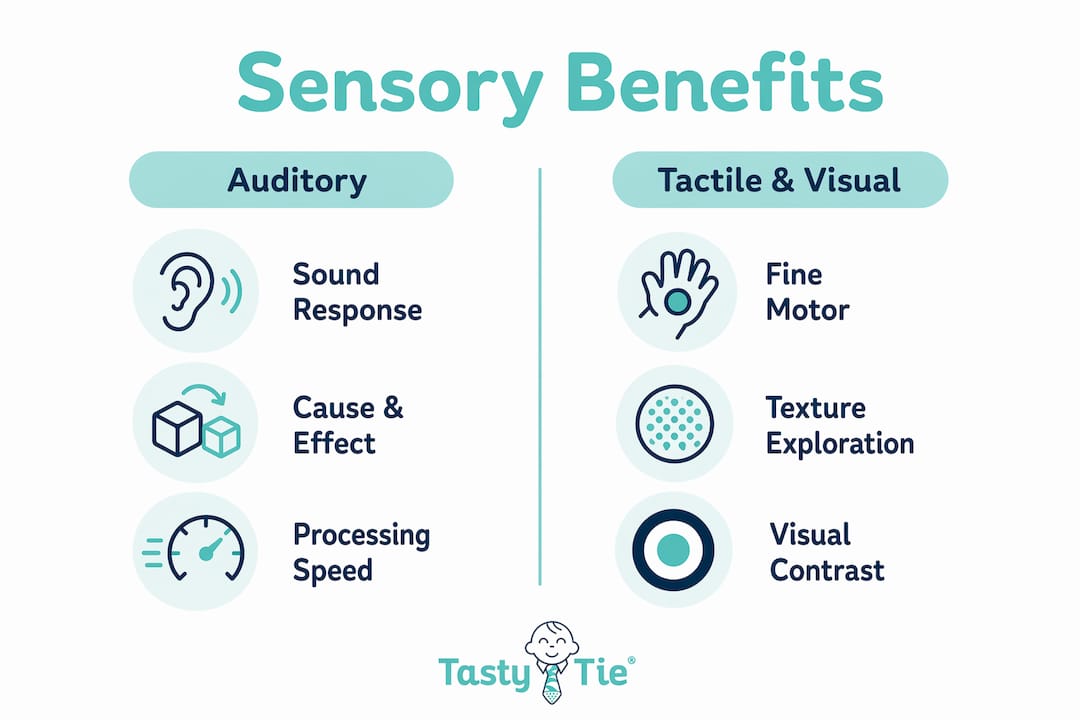
Crinkle toys deliver more than sound. Their real developmental power comes from combining auditory, tactile, and visual stimulation in a single object the baby controls. That multi-sensory integration is what separates crinkle toys from simpler rattles or squeakers.
On the tactile side, the textured fabric of most crinkle toys promotes fine motor skills and grasping, including the two-handed grip that babies develop between three and six months. Grasping a soft, crinkly object requires the baby to coordinate finger pressure, hand position, and arm strength simultaneously. That is a significant motor workout for a four-month-old.
| Developmental area | How crinkle toys help | Compared to a standard rattle |
|---|---|---|
| Auditory processing | Consistent, predictable sound on touch | Sound requires shaking, less contingent |
| Fine motor skills | Soft texture encourages grasping and squeezing | Smooth surface offers less tactile feedback |
| Visual development | High-contrast patterns support early vision | Typically single color or simple design |
| Cause-and-effect learning | Immediate sound feedback on touch | Delayed or inconsistent feedback |
| Multi-sensory integration | Combines touch, sound, and sight | Primarily auditory |
Research on sensory books for babies confirms that objects combining tactile, auditory, and visual stimulation under the baby’s own control produce stronger multi-sensory integration than passive toys. That self-directed control is the key variable. When the baby causes the sound, the brain connects action to outcome in a way that passive listening simply cannot replicate.
Pro Tip: Look for crinkle toys with high-contrast black and white or bold color patterns. Babies under three months see contrast more clearly than color, so pairing crinkle sounds with high-contrast visuals gives you double the developmental return.
How should caregivers choose and use crinkle toys effectively?
Not all crinkle toys deliver equal developmental benefits. The design details matter more than most parents realize. Here is a practical framework for selecting and using them well.
-
Prioritize safe materials. Choose crinkle toys made from organic cotton or BPA-free fabrics with non-toxic dyes. Babies mouth everything, so the toy’s surface must be safe for extended oral contact. Secure stitching is non-negotiable. Loose threads or poorly attached parts are choking hazards.
-
Choose an easy-to-grab shape. A toy that is too large, too stiff, or too smooth will frustrate a young baby rather than engage them. The best crinkle toys for infants are soft, lightweight, and shaped so a small hand can get a grip without help. Easy-to-grab designs with secure stitching maximize the baby’s ability to interact independently.
-
Favor predictable sounds over complex ones. Research on temporal contingency in infants shows that unpredictable or electronically complex sounds reduce the cause-and-effect learning benefit. A simple, consistent crinkle sound every time the baby touches the toy is more neurologically valuable than a toy that plays random melodies.
-
Engage with your baby during play. Name the sound. Say “crinkle!” when the toy makes noise. Point to it. This caregiver interaction connects the auditory experience to language, which amplifies the developmental benefit significantly. Australian health guidelines recommend interactive sensory play over passive screen time for infants under two years, and crinkle toys fit that recommendation perfectly.
-
Avoid overstimulation. Keep crinkle toy sessions to 10 to 15 minutes at a time for young infants. Watch for signs of disengagement like turning away or fussing. Those are your baby’s signals that their brain needs a break.
Crinkle toys vs. other sensory toys: which is best for brain development?
Crinkle toys are not the only sensory option, but they occupy a specific and valuable niche. Understanding how they compare to other popular choices helps you build a well-rounded toy collection rather than duplicating the same developmental benefit.
| Toy type | Primary sense engaged | Cause-and-effect feedback | Best developmental use |
|---|---|---|---|
| Crinkle toy | Auditory and tactile | High (immediate on touch) | Attention, motor skills, auditory processing |
| Rattle | Auditory | Medium (requires shaking) | Gross motor, early auditory awareness |
| Squeaker toy | Auditory | High (requires squeeze) | Cause-and-effect, hand strength |
| Textured ball | Tactile | Low | Fine motor, sensory exploration |
| High-contrast book | Visual | Low | Visual tracking, early literacy |
The crinkle toy’s advantage is the combination of high tactile feedback and immediate, consistent auditory response. That pairing is what makes it particularly effective for infant fine motor skill development alongside auditory processing. Rattles require shaking, which is a gross motor action. Crinkle toys respond to the gentler, more precise squeeze and grasp movements that build fine motor control.
The best approach is to use crinkle toys alongside rattles, textured balls, and high-contrast books. Each type targets a slightly different developmental area, and rotating them keeps your baby engaged and challenged.
Why I think crinkle toys are underrated by most parents
Most parents reach for rattles first because rattles are familiar. Crinkle toys tend to get gifted and then set aside, which is a real missed opportunity. In my experience working with parents and caregivers around sensory play, the babies who get consistent crinkle toy interaction in the three to six month window show noticeably stronger grip and attention during play. That is not a coincidence.
The piece of advice I give most often is this: do not treat crinkle toys as passive entertainment. The moment you start responding to the sound with your baby, naming it, reacting to it, and encouraging them to make it again, the toy becomes a language and attention tool, not just a distraction. That shift in how you use it changes what your baby gets from it.
One common pitfall I see is parents choosing crinkle toys based on how cute they look rather than how well they function. A toy that only crinkles in one corner, or requires significant force to produce sound, will not hold a young baby’s interest. The sound needs to be immediate and reliable. That reliability is the whole point.
— Tasty
The TastyTie teething tie: crinkle sound meets everyday wear
If you are looking for a crinkle sound toy that works while your baby is dressed and on the go, the TastyTie teething tie is worth a close look. It is the only teething toy on the market that clips directly to your baby boy’s outfit, absorbs drool, and produces a crinkle sound for sensory stimulation. Made from organic cotton and designed for babies between 3 and 12 months, it checks every box covered in this article: safe materials, easy to grab, predictable crinkle sound, and self-directed play. With over 35,000 units sold and a 4.7-star rating on Amazon, it has earned its reputation as a practical, developmental gift that parents actually use. You can also explore the Blue Bodysuit Bundle for a complete gifting option that pairs the teething tie with a matching outfit.
FAQ
What age should babies start using crinkle sound toys?
Crinkle sound toys are appropriate from birth, as newborns can already detect and respond to consistent auditory stimuli. Most babies begin actively grasping and squeezing crinkle toys between three and five months.
Why do crinkle sounds specifically benefit infant brain development?
Crinkle sounds are predictable and contingent on the baby’s own touch, which trains the brain’s auditory processing and cause-and-effect reasoning simultaneously. Research shows newborns are neurologically primed to detect coherent sound patterns in noise, making crinkle toys a natural fit for early sensory development.
Are crinkle toys safe for babies who mouth everything?
Yes, provided the toy is made from non-toxic, BPA-free materials with secure stitching and no small detachable parts. Always check that the fabric is labeled safe for mouthing and that seams are reinforced.
How do crinkle toys compare to electronic sound toys for brain development?
Crinkle toys produce sound only when the baby acts on them, which creates a direct cause-and-effect learning loop. Electronic toys that play sounds automatically or unpredictably offer less neurological benefit because the baby’s action is not reliably connected to the sound output.
Can crinkle toys help with speech development?
Crinkle toys support the auditory processing and selective attention skills that underpin early speech perception. When caregivers name the sound and engage verbally during play, the developmental connection to early language development becomes even stronger.

