


Cognitive Development Toys Under 1 Year: A Parent's Guide
TL;DR:
- Cognitive development toys for infants under one year should be simple, sensory-rich, and foster caregiver interaction to promote early skills. Using age-appropriate, safe toys that support cause-and-effect learning enhances brain connections, especially through active engagement. Prioritizing quality time and adult participation over toy complexity yields the most meaningful developmental benefits.
Cognitive development toys for infants under one year are defined as objects designed to stimulate sensory processing, early problem-solving, and motor skill formation through age-appropriate, interactive play. The formal term used by child development specialists is “sensorimotor play materials,” though most parents simply call them learning toys or brain development toys. What matters most is not the label but the principle: the right toy at the right stage gives your baby’s developing brain exactly the input it needs to grow. This guide breaks down the best options by age, feature, and developmental goal so you can shop with confidence.
1. What makes a good cognitive development toy for infants under 1 year?
The single most important feature in any educational toy for infants is simplicity. Repeatable, predictable responses are the engine of early cognitive skill-building because they teach babies that their actions produce consistent outcomes. A rattle that always shakes, a crinkle cloth that always crinkles, a mirror that always reflects. These are not boring to a baby. They are revelations.
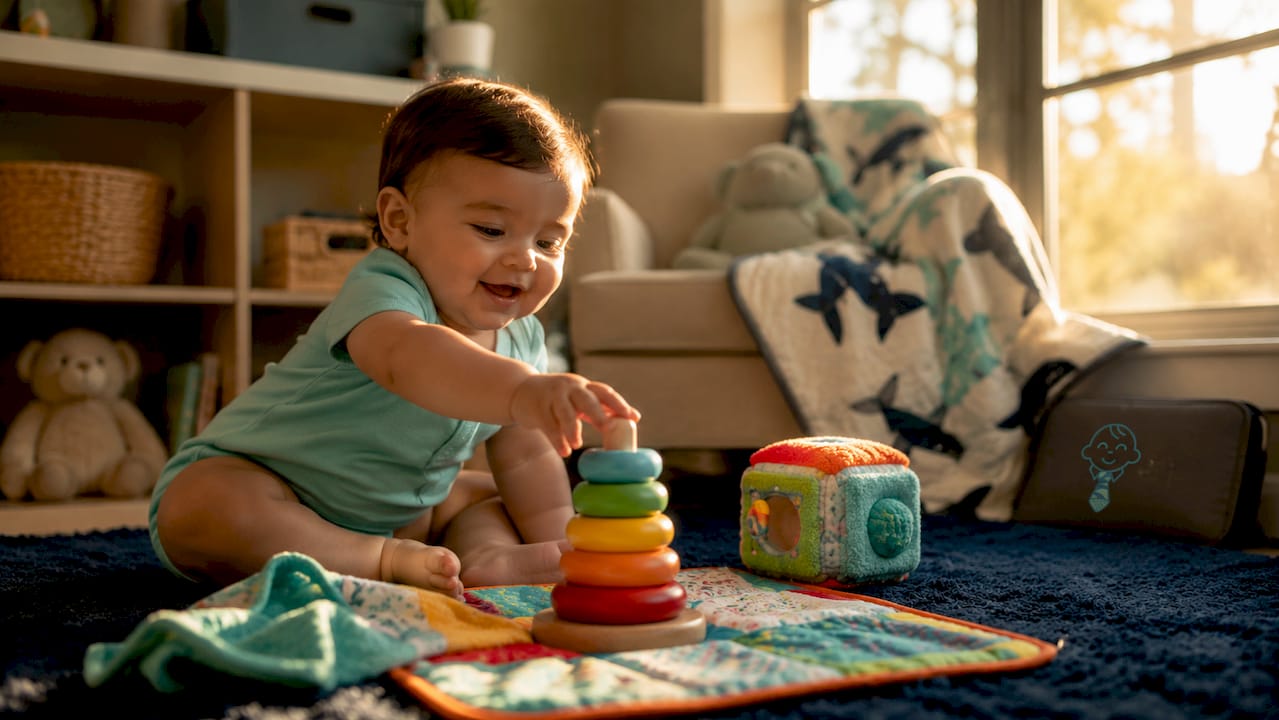
The second feature is sensory richness. Toys that engage sight, sound, and touch simultaneously give the brain more to process and more connections to form. High-contrast patterns, soft textures, and gentle sounds all qualify. The third feature is caregiver compatibility. Back-and-forth play between adult and infant builds communication and problem-solving skills far more effectively than any toy used alone.
2. Best toys for babies aged 0 to 6 months: sensory foundations
For the first six months, a baby’s primary job is learning to track, reach, and respond. The toys that support this are deliberately low-tech.
- High-contrast black-and-white cards and books. Newborn vision is limited to about 8 to 12 inches. High-contrast patterns are the clearest visual input a young baby can process, making them ideal for early tracking practice.
- Soft rattles and crinkle cloths. Sensory toys like these stimulate early visual tracking and reaching, forming the foundation for hand-eye coordination.
- Baby-safe mirrors. Unbreakable fabric or plastic mirrors encourage visual focus and early social awareness. Babies at this stage are fascinated by faces, including their own.
- Spiral hanging mobiles. A high-contrast mobile hung 20 to 30 cm from the infant’s face, gently spinning, supports visual tracking without overwhelming a young nervous system.
Pro Tip: Position any visual toy within your baby’s focal range and move it slowly side to side. Pause. Watch your baby’s eyes follow. That pause is where the learning happens.
3. How cognitive toys support babies aged 6 to 12 months
From six months onward, babies shift from passive observation to active exploration. They grab, mouth, bang, and drop with purpose. The best cognitive toys for 0 to 12 months at this stage are built around cause-and-effect learning.
- Stacking cups and shape sorters. These build hand-eye coordination and early spatial reasoning. A baby who fits a shape into a hole is solving a problem, not just playing.
- Activity cubes. Multiple interactive panels on one toy give babies a range of actions to explore, pressing, spinning, and sliding, each teaching a different motor and cognitive skill.
- Tummy time mats with multisensory features. The Hape x The Met Tree of Life mat combines mirrors, teethers, crinkle flaps, and high-contrast visuals in one surface. Tummy time mats that convert from flat to standing modes offer multi-stage engagement by changing infant posture and visual focus across the full 0 to 12 month range.
- Battery-free rattles and wooden toys. Simple, repeatable toys without batteries provide better sensory and cognitive stimulation than complex electronic entertainers. The PlanToys Penguin Wobbler, made from chemical-free rubberwood, is a strong example: it promotes visual tracking and reaching from birth onward without a single battery.
4. Comparing the main toy categories for infants under 1 year
| Toy type | Best age range | Key cognitive benefit | Safety note |
|---|---|---|---|
| Sensory rattles and crinkle toys | 0 to 6 months | Auditory and tactile stimulation | Choose BPA-free, non-toxic materials |
| High-contrast cards and mobiles | 0 to 4 months | Visual tracking and focus | Keep mobile out of reach once baby can push up |
| Baby-safe mirrors | 2 to 8 months | Social awareness and visual engagement | Must be unbreakable fabric or plastic |
| Activity gyms and play mats | 3 to 9 months | Motor skills and cause-and-effect | Check attachment points regularly |
| Teethers and clip-on toys | 3 to 12 months | Oral sensory input and fine motor skills | Organic cotton or food-grade silicone only |
| Stacking cups and shape sorters | 6 to 12 months | Spatial reasoning and problem-solving | No small parts that detach |
Teethers deserve special mention here. Most parents think of them purely as pain relief tools, but a good teether is also an interactive toy for young babies. The act of grasping, mouthing, and manipulating a teether builds fine motor skills and oral sensory awareness simultaneously. The crinkle sound in teething toys adds an auditory layer that further engages a baby’s developing brain.
5. How to choose and use cognitive development toys safely
Selecting the right toy is only half the equation. How you use it matters just as much.
- Match the toy to your baby’s current milestone. Age-appropriate toy selection aligned with physical and cognitive abilities supports multiple developmental domains at once. A four-month-old does not benefit from a shape sorter. A ten-month-old is bored by a simple rattle.
- Keep sessions short and responsive. Babies signal when they are done. Turning away, fussing, or losing eye contact all mean the session is over. Pushing past these cues causes overstimulation, not learning.
- Prioritize interaction over passive play. Face-to-face engagement and real-world interaction outperform any screen-based alternative for early learning. Put the tablet away. Get on the floor.
- Check materials carefully. Look for BPA-free plastics, food-grade silicone, organic cotton, and non-toxic finishes. Babies mouth everything. Material safety is non-negotiable.
- Rotate toys regularly. Novelty drives attention. Swapping out toys every few days keeps your baby engaged without requiring a larger collection.
Pro Tip: Use the “position, pause, respond” cycle with any new toy. Place it near your baby’s face, wait for a reach or gaze, then respond with a smile or sound. This back-and-forth is the actual cognitive workout.
What I’ve learned about toys and infant development
Here is something most toy guides will not tell you: the toy itself is almost never the most important variable. I have watched babies light up over a crinkle cloth and ignore a $60 activity cube. What made the difference every time was the adult in the room.
Caregiver interaction is more influential for infant cognitive development than toy complexity. This is not a soft opinion. It is one of the most consistent findings in developmental research. The toy is a prop. You are the curriculum.
That said, the right prop still matters. Simple, sensory-rich, screen-free toys give you and your baby a shared focal point. They create the conditions for interaction. The best ideas for baby learning toys are the ones that invite you to participate, not the ones that entertain your baby so you can step away. When I see parents reach for a tablet to buy themselves five minutes, I understand the impulse completely. But screen use is not recommended as a substitute for the real-world engagement that actually builds a baby’s brain.
My honest recommendation: spend less on toys and more on time on the floor. Then pick two or three well-made, sensory-rich toys that you genuinely enjoy using together.
— Tasty
TastyTie: a cognitive toy that goes everywhere you do
If you are looking for a cognitive development toy that checks every box, the TastyTie teething tie is worth a close look. It clips directly to your baby’s outfit, so it never hits the floor, never gets lost in the diaper bag, and is always within reach for self-soothing and sensory exploration. Made from organic cotton with a built-in crinkle sound, it engages touch, hearing, and oral sensory input all at once. It is machine washable, BPA-free, and designed specifically for baby boys aged 3 to 12 months. With over 35,000 units sold and a 4.7-star rating on Amazon, it is one of the most practical infant sensory teethers on the market. It also makes a genuinely memorable baby shower gift.
FAQ
What are the best cognitive development toys for newborns?
High-contrast black-and-white cards, soft rattles, and baby-safe mirrors are the most effective cognitive toys for newborns. These support early visual tracking and tactile stimulation, which are the primary sensory skills developing in the first two months.
At what age should I introduce cause-and-effect toys?
Cause-and-effect toys like stacking cups, activity cubes, and press-and-squeak toys are appropriate from around 6 months. At this stage, babies have the motor control to activate toys intentionally and the cognitive capacity to connect their actions to outcomes.
Are battery-powered toys bad for infant development?
Battery-powered toys are not harmful, but simple, battery-free options are generally better for infants under one year. Toys with repeatable, predictable responses provide more meaningful cognitive stimulation than complex electronic toys that can overwhelm a young baby’s sensory system.
How long should play sessions be for babies under 1 year?
Play sessions for infants under one year should follow the baby’s lead, typically lasting 5 to 15 minutes before signs of overstimulation appear. Short, frequent sessions with caregiver interaction are more beneficial than longer passive play periods.
Can a teether count as a cognitive development toy?
A teether absolutely qualifies as a cognitive development toy when it engages multiple senses. Teethers that include crinkle sounds, varied textures, and graspable shapes support fine motor skills, oral sensory development, and auditory stimulation simultaneously.

