


Teething Toy Crinkle Sound Benefits for New Parents
TL;DR:
- Crinkle sound toys promote auditory and sensory development by reinforcing cause-and-effect learning and offering calming stimulation for infants. They also enhance fine motor skills through repetitive grasping, squeezing, and transferring while supporting safe, age-appropriate exploration. Proper safety features, such as built-in crinkle layers and BPA-free materials, are essential for minimizing hazards and ensuring safe use.
Every parent knows that moment: your baby is fussing, gums aching, and nothing seems to help. You reach for a teething toy, and the second that soft little crinkle sound fires off, your baby goes quiet and wide-eyed. That reaction is not a coincidence. The teething toy crinkle sound benefits are real, well-supported, and worth understanding before you buy. This article walks you through exactly what is happening in your baby’s brain and body when they interact with crinkle sound toys, and why those soft rustling noises do far more than just keep them occupied.
Table of Contents
- Why crinkle sounds support auditory and sensory development
- How crinkle toys build motor skills and coordination
- What every parent should know about crinkle toy safety
- How crinkle toys compare to other teething options
- Making crinkle toys work in your daily teething routine
- My honest take on crinkle toys and infant development
- The Tastytie teething tie: crinkle sound built into every wear
- FAQ
Why crinkle sounds support auditory and sensory development
Babies are wired to respond to sound from their very first days. Gentle, rhythmic noises feel familiar because they echo sounds heard in the womb. Crinkle sounds fall into that sweet spot: soft enough to feel safe, interesting enough to demand attention.
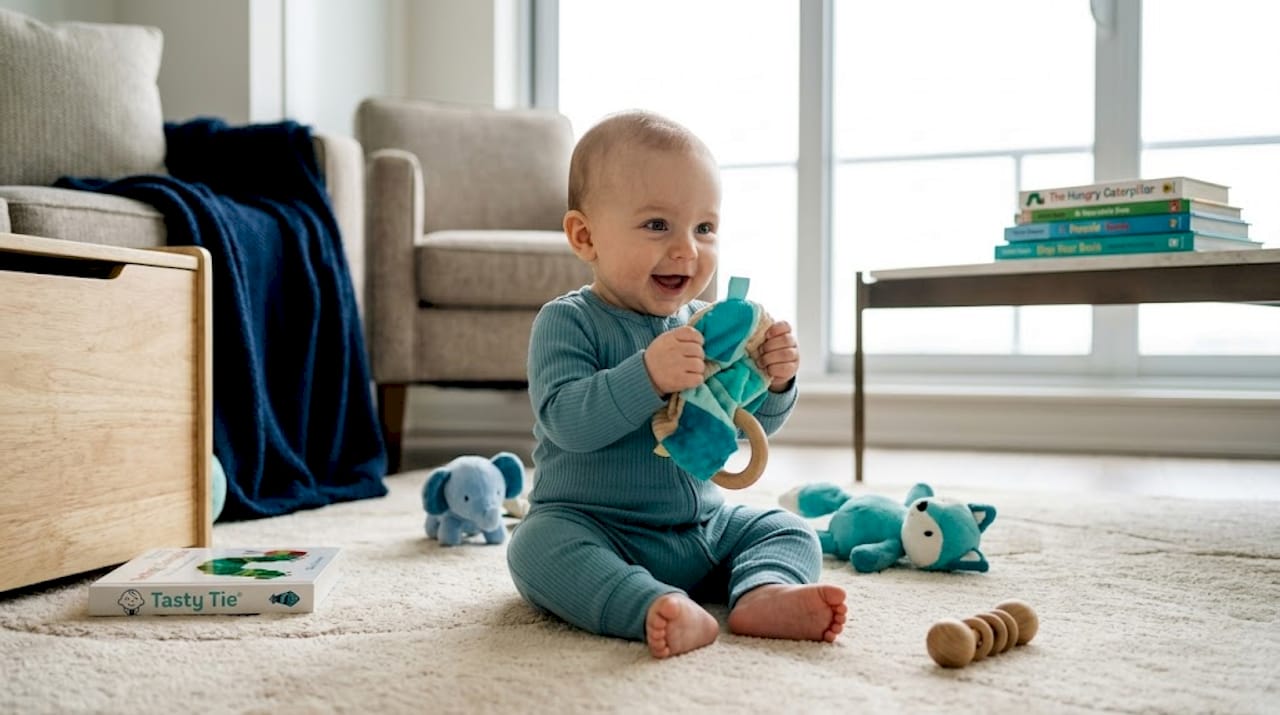
The real magic happens when a baby squeezes a crinkle toy and hears the sound follow immediately. That connection between action and response is how cause-and-effect learning gets wired in. Infants as young as three months start to grasp this relationship, and crinkle toys give them a low-stakes, endlessly repeatable way to practice it. They squeeze, they hear something happen, and their brain registers: “I did that.”
What separates crinkle sound toys from louder, more aggressive options is the volume and quality of sound they produce. Sudden, high-pitched squeakers can genuinely startle young infants, spiking stress rather than relieving it. Crinkle sounds mimic calm environmental noise rather than sharp squeaks, keeping babies in an alert but relaxed state that is ideal for play and learning.
Here is what makes crinkle sound toys genuinely useful for sensory development:
- Auditory engagement: Even the gentlest squeeze produces a response, rewarding the baby’s exploration.
- Focused attention: The soft, unpredictable nature of crinkle sounds draws and holds a baby’s gaze, supporting early attention skills.
- Multi-sensory learning: When sound pairs with texture and movement, the brain builds richer neural connections than any single sensory input could create alone.
- Self-directed discovery: Babies learn they can control their environment, which supports early confidence.
Pro Tip: Introduce crinkle toys during calm, awake windows rather than when your baby is already overtired. That is when their sensory processing is sharpest and the learning benefit is highest.
How crinkle toys build motor skills and coordination
There is more going on than meets the eye when a baby grabs a crinkle toy. The physical act of reaching, grasping, squeezing, and transferring the toy from hand to hand is a full workout for the small muscles in your baby’s hands and wrists. These are the same muscles that will eventually hold a crayon, turn a page, and button a shirt.
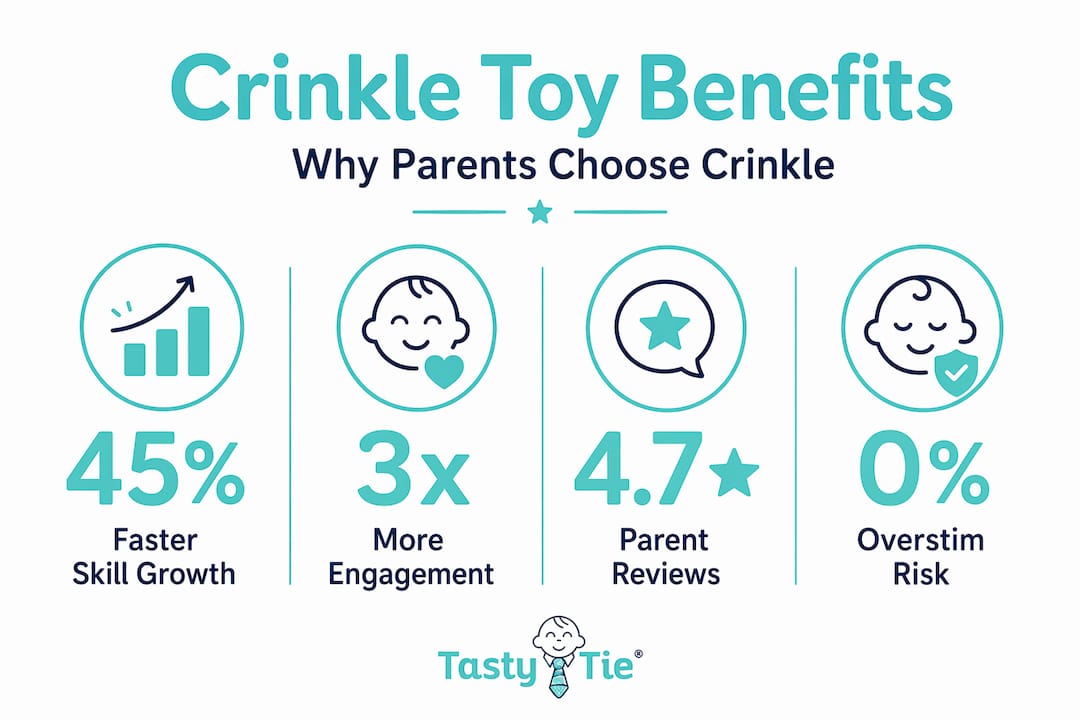
Crinkle toys build fine motor skills through tactile and auditory feedback that makes repetition feel rewarding rather than tedious. Because the toy “responds” with a sound every time, babies stay motivated to keep squeezing and manipulating it, giving those tiny hand muscles more reps than a silent teether ever would.
Here is a simple progression of motor milestones that crinkle toys support:
- Reaching and grasping (3 to 5 months): Babies practice controlling arm movements and closing their fingers around an object.
- Two-handed exploration (5 to 7 months): Babies pass the toy between hands, which requires bilateral coordination that is a foundational motor skill.
- Pincer-grip practice (7 to 9 months): Babies begin using their thumb and forefinger to grip specific parts of the toy, preparing for more precise hand control.
- Purposeful squeezing (8 to 12 months): Babies learn to produce the crinkle sound intentionally, connecting a deliberate physical action to a desired outcome.
Check out infant fine motor skill toys for a broader look at how different toy types support each developmental stage. The consistent feedback loop that crinkle toys provide is exactly what makes them so effective for this kind of early physical development.
What every parent should know about crinkle toy safety
Not every teething toy with sound is created equally. Safety should be the first filter before any other consideration, and recent data backs that up strongly.
In 2026, over 150,000 pull-string teething toys were recalled after nearly a dozen choking incidents linked to long silicone strings. Separately, pull-string toys with silicone tentacles were listed as hazardous by regulatory agencies. These incidents highlight a specific design risk: sound-producing features that involve detachable components or elongated parts.
Safety note: Any teething toy that produces sound through a string, pull mechanism, or removable insert carries a higher risk profile than one where the sound comes from the material itself. Always inspect new toys before giving them to your baby.
Well-designed crinkle sound toys avoid these risks by building the sound into the fabric or inner lining. BPA-free recycled plastic inside fabric layers creates the crinkle effect without any loose parts, detachable strings, or chemical exposure concerns.
Before buying any crinkle sound teether, check for:
- BPA-free and non-toxic material certifications
- No small parts that could detach during chewing
- No strings, loops, or pull mechanisms longer than a few centimeters
- Machine-washable construction, because clean toys are safe toys
- Age-appropriate sizing so the toy cannot fit entirely in a baby’s mouth
For a deeper look at materials to avoid, toy material safety guidance offers practical information parents can apply to any teething toy purchase.
How crinkle toys compare to other teething options
Parents are faced with a crowded market. Silent teethers, squeaker toys, freezable rings, and multi-sensory teethers all promise relief. Understanding what each type actually delivers helps you choose without guessing.
| Teething toy type | Sound feedback | Sensory stimulation | Overstimulation risk | Ease of use |
|---|---|---|---|---|
| Crinkle sound toy | Soft, gentle rustle | High (touch + sound) | Low | High |
| Squeaker toy | Sharp, high-pitched | Moderate | Moderate to high | High |
| Silent textured teether | None | Moderate (touch only) | Very low | High |
| Freezable ring teether | None | Moderate (touch + cold) | Very low | Moderate |
| Multi-sensory teether | Varies | Very high | Moderate | Moderate |
Multi-sensory teethers with textures and sounds are seeing 10 to 13% annual growth, outpacing basic gum relief products. Parents are voting with their wallets for toys that do more than one thing. Crinkle sound toys hit a practical middle ground: they provide genuine auditory stimulation without the sharpness of squeakers, and they hold a baby’s interest far longer than a silent option because crinkle sounds reward even gentle movements, extending engagement and preventing the kind of frustrated boredom that escalates into fussing.
Making crinkle toys work in your daily teething routine
Knowing the benefits is one thing. Using them consistently is where it counts. Here is how to get the most out of crinkle sound toys in your day-to-day life.
Pro Tip: Rotate between two or three teething toys every few days. Babies habituate quickly to familiar stimuli, and a toy that has been “rested” briefly feels genuinely novel again, which means more engagement and more developmental benefit per session.
- Introduce early, around three months: You do not need to wait for visible teeth. Crinkle toys support sensory and motor development long before teething begins in earnest.
- Supervise all play, especially under six months: Younger babies cannot yet manage large objects safely on their own.
- Keep toys clean: Machine-washable options remove the friction of frequent cleaning and make it easy to maintain hygiene without thinking twice.
- Combine with other soothing methods: Crinkle toys work well alongside gentle gum massage, a cool teething ring, or a calm environment. No single tool does everything.
- Watch your baby’s cues: If a crinkle toy is causing overstimulation rather than soothing, your baby will show you. Turning away, arching, or crying are signs to try something quieter for that session.
The goal is not to find one perfect toy. It is to build a small toolkit of options you can rotate based on what your baby needs in the moment. For parents wondering why teethers drop on the floor, clip-on designs solve that problem immediately and make crinkle toys genuinely practical for travel, outings, and busy days.
My honest take on crinkle toys and infant development
I have spent years paying close attention to what parents actually experience with teething toys versus what marketing materials promise. Here is what I have learned.
The biggest misconception I run into is that “noisy” toys are inherently too stimulating for young babies. Parents worry they are doing harm by choosing something that makes sound. In my experience, that fear conflates squeakers and electronic toys with crinkle materials, and those two things are genuinely different. A crinkle sound is soft, brief, and baby-controlled. That distinction matters a lot.
What I find most compelling is the self-direction angle. Babies who can produce a crinkle sound on their own are practicing something far more important than entertainment. They are learning that their actions have consequences. That is the foundation of confidence. A baby who learns “I squeezed this and something happened” is a baby building agency, and that is worth taking seriously.
My honest advice: do not overthink the toy selection. Prioritize safety, choose soft materials over hard plastic, and look for a toy your baby can actually hold and manipulate on their own. If it crinkles, so much the better.
— Tasty
The Tastytie teething tie: crinkle sound built into every wear
If you are looking for a crinkle sound teether that actually fits into your life, the Tastytie teething tie was designed to solve every practical problem parents run into. It clips directly onto your baby boy’s outfit, so it never hits the floor. It is made from organic cotton, absorbs drool, and features a built-in crinkle sound that keeps babies entertained and self-soothing without any extra effort from you. It is machine washable, BPA-free, and sized for babies three to twelve months old.
With a 4.7-star rating and over 450 reviews on Amazon and more than 35,000 units sold, it is one of the most trusted clip-on teething toys for baby boys on the market. Parents love it for daily use and gift givers love it because it is practical, stylish, and genuinely different from anything else in the baby aisle.
FAQ
What are the main teething toy crinkle sound benefits?
Crinkle sound toys support auditory development, cause-and-effect learning, and fine motor skill growth by rewarding a baby’s squeezing and grabbing with immediate sound feedback. They also soothe teething discomfort through combined tactile and auditory stimulation.
Are crinkle sound toys safe for babies?
Yes, when designed without loose parts, strings, or chemical materials. Look for BPA-free, non-toxic fabrics with the crinkle material built into the lining rather than attached as a removable component.
How do crinkle toys compare to squeaker toys for infants?
Crinkle sounds are softer and less startling than high-pitched squeakers, making them better suited for young infants who are still sensitive to sudden loud noises. Crinkle toys keep babies in a calm, exploratory state rather than triggering a startle response.
When should I introduce a crinkle teething toy?
You can introduce crinkle toys as early as three months old. At that age, babies are beginning to reach and grasp, and the auditory feedback from crinkle toys supports both motor and sensory milestones well before teeth appear.
Can crinkle toys help with self-soothing?
Yes. Because babies control the sound themselves by squeezing and manipulating the toy, crinkle sound toys encourage independent play and early self-soothing. This is one of the reasons clip-on crinkle teethers are especially popular with parents who need hands-free options during outings.

