


Clip-On Teether Safe Use Guide for New Parents
TL;DR:
- Parents should choose clip-on teethers that meet strict safety standards to prevent strangulation and choking hazards. Proper attachment, regular inspection, and supervision during supervised times significantly reduce risks, especially when placed on sturdy fabric at chest level. The safest options include products like the TastyTie teething tie, made from organic materials and designed with safety in mind.
Teething starts earlier than most parents expect, and the hunt for relief solutions starts just as fast. Clip-on teethers, also called wearable teethers or teething accessories that attach directly to clothing, have become a go-to option because babies can reach them independently and they won’t land on the floor every five minutes. But this convenience comes with real safety considerations that are easy to overlook when you’re sleep-deprived and just trying to get through the day. This clip-on teether safe use guide covers everything you need to know before clipping anything to your baby’s outfit.
Table of Contents
- What you need to know before using a clip-on teether
- How to use a clip-on teether safely, step by step
- Common mistakes that create avoidable risks
- What safe use actually looks like in practice
- My honest take on clip-on teether safety
- Why the TastyTie teething tie gets this right
- FAQ
What you need to know before using a clip-on teether
Not every product marketed as a “clip-on teether” is built to the same safety standard. Before attaching anything to your baby’s clothing, understanding the difference between safe and risky designs is non-negotiable.
The most serious concern is strangulation. Health Canada warns that wearable teething products can twist or catch on furniture and hooks, creating life-threatening entanglement hazards. This applies to teething necklaces worn around the neck, but it also extends to any clip-on design that creates a cord, loop, or ribbon between the clip and the teether. If a teether hangs by a string, it can form a loop. A loop around an infant’s neck is a strangulation risk.
Choking is the second major hazard. HealthyChildren.org recommends that all toy parts be larger than a child’s mouth and that loose ribbons or strings be removed entirely. Some clip-on teethers sold online include decorative beads, jewel accents, or small detachable rings. Any part that can separate becomes a choking hazard instantly.
Age matters too. Most teething accessories are not appropriate before 3 to 4 months of age. Before that, infants lack the neck control and motor coordination to safely manage a clip-on object near their face.
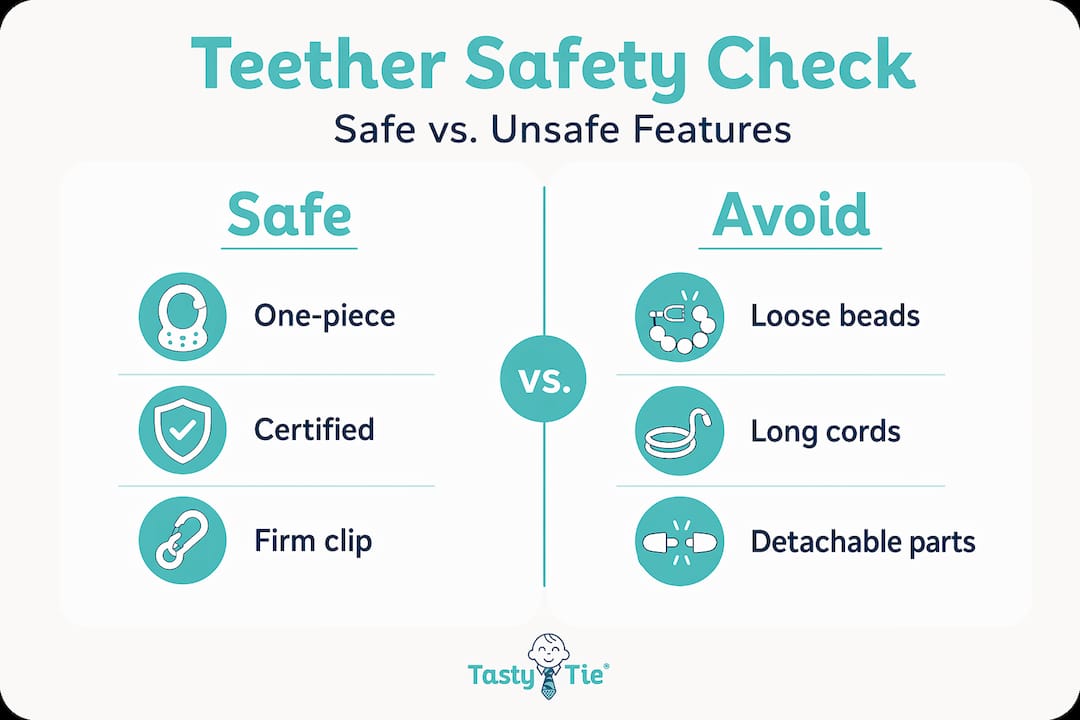
Here is a quick reference for evaluating any product before purchase:
| Safe features | Features to avoid |
|---|---|
| Single-piece or firmly fused design | Detachable beads, rings, or decorative parts |
| Clip attaches directly to teether with no cord | Cords, ribbons, or strings between clip and teether |
| Food-grade silicone or organic cotton materials | Hard plastics, BPA-containing materials, or painted finishes |
| Clip designed for fabric attachment only | Clips designed to hang around the neck or wrist |
| Machine washable or easy to sanitize | Materials that trap bacteria and can’t be cleaned |
Pro Tip: Look for teethers that carry third-party safety certifications or meet ASTM F963 toy safety standards. A brand that openly states its materials and testing process is always a better bet than one that doesn’t.
How to use a clip-on teether safely, step by step
Knowing what to buy is only half of it. How you attach and supervise a clip-on teether matters just as much as the product itself. Here are the steps that make safe use consistent.
-
Inspect before every single use. Look at the clip mechanism, the teether body, and any connection between the two. Repeated chewing and tugging can loosen clip mechanisms or decorative parts over time. If anything looks cracked, stretched, or loose, retire the product immediately.
-
Choose a secure attachment point on sturdy fabric. Health Canada advises securing clip-on teethers to stable fabric areas like a bib strap or the chest of a onesie. Avoid flimsy fabric edges, thin collars, or any point where the clip could easily pull free.
-
Position the teether at chest level or below. The teether should be within easy reach of the baby’s hands and mouth but never positioned so that it could reach the throat or face unsupported.
-
Never attach above the collarbone. Any attachment point near or above the neck creates a direct strangulation risk if the teether shifts position or gets caught on something.
-
Stay present during teething sessions. The AAP’s guidance stresses close supervision during teething to prevent choking hazards. Clip-on teethers are tools for supervised use, not independent play.
-
Remove the teether before sleep, naps, or time in a crib or car seat. This is firm. A clip-on teether worn during sleep or in a confined, padded space increases both entanglement and suffocation risk dramatically.
-
Clean regularly. Most food-grade silicone and organic cotton teethers can be wiped down with warm soapy water or run through the washing machine. Check the manufacturer’s cleaning instructions and follow them. A dirty teether introduces bacteria directly into your baby’s mouth.
Pro Tip: Set a weekly reminder to inspect all teething toys, not just clip-ons. Checking for wear during a regular routine makes it far less likely you’ll miss early signs of damage.
For more guidance on where exactly to place the clip on different outfit types, the Tasty Tie guide on outfit attachment goes into helpful detail.
Common mistakes that create avoidable risks
Most clip-on teether incidents don’t happen because parents were careless. They happen because certain risks are easy to underestimate. Here are the mistakes worth knowing about before they become problems.
-
Clipping to a loose or thin fabric edge. A clip that can easily slide or detach is worse than no clip at all. If the teether detaches and falls into a crib or bouncer, it becomes a loose object in a sleep space.
-
Using a teether past its safe lifespan. Some dummy clips sold online have failed product safety regulations due to parts detaching during normal use. Visible wear is a clear sign to discard a product, not a reason to “use it until it breaks.”
-
Assuming price equals safety. Budget products and premium-looking products can both carry risks. The design matters far more than the price point.
-
Leaving the teether clipped during car travel without supervision. Even in a car seat, an unsupervised teether can shift into an unsafe position.
-
Attaching to clothing near the neck because it “looks like a tie.” Unless the product is specifically designed to be worn as a clothing accessory with safety in mind (like a teething tie), teething jewelry near the neck poses documented strangulation risk.
If you notice any sign of damage, detachment, or unusual wear on a clip-on teether, stop using it immediately and do not attempt to repair it. A teether that has been compromised should be discarded, not fixed. Baby safety accessories are not worth the gamble of repair.
What safe use actually looks like in practice
When you follow the guidelines above, the outcome is a noticeably calmer teething experience for your baby and far less anxiety for you.

A baby who can self-soothe with a teether that stays within reach is learning early independence. Teething discomfort doesn’t disappear, but having a safe, accessible chew object means fewer escalation cycles of crying and frustration. Dr. Deepa Aggarwal emphasizes that age-appropriate, supervised teether use is one of the most effective ways to manage teething discomfort without medication.
Here is a side-by-side look at safe versus unsafe outcomes based on how clip-on teethers are used:
| Approach | Likely outcome |
|---|---|
| Clip attached to sturdy fabric at chest level | Teether stays accessible and in safe position |
| Regular inspection before each use | Early detection of wear before failure occurs |
| Removed during sleep and unsupervised time | Eliminates the highest-risk scenarios entirely |
| Teether with no detachable parts or cords | Choking and strangulation risk significantly reduced |
| Left clipped during naps or overnight | High risk of entanglement or suffocation |
For parents exploring other relief options alongside clip-on teethers, this overview of teething relief options by age is worth reading.
My honest take on clip-on teether safety
In my experience watching how parents actually use teething accessories day to day, the biggest gap isn’t product knowledge. It’s supervision consistency. Parents learn the rules, choose a safe product, and then get comfortable over time. The teether stays clipped a bit longer. The daily inspection becomes a weekly one. That’s where risk quietly accumulates.
I’ve also noticed that attachment location gets underestimated. Most guides say “clip it to the outfit” and leave it there. But where on the outfit matters enormously. A clip placed too close to the neckline on a fussy baby who moves a lot is meaningfully different from one placed at the center chest of a well-fitting onesie. These aren’t the same scenario.
My honest recommendation is to treat clip-on teether safety the same way you treat car seat safety. You set the habit once, correctly, and you don’t let it drift. If you’re ever unsure whether a product or practice is appropriate for your baby’s age and development, ask your pediatrician directly. That conversation takes two minutes and removes all guesswork.
— Tasty
Why the TastyTie teething tie gets this right
If you’ve read this far and you’re looking for a clip-on teether that checks every safety box, the TastyTie teething tie was built specifically with these concerns in mind. It’s made from GOTS-certified organic cotton, which means no harmful dyes or finishes near your baby’s mouth. It clips directly to outfits with no cord between the clip and the chewable fabric, eliminating one of the most common strangulation risks by design.
The teething tie is also machine washable, which makes the cleaning step genuinely easy to maintain consistently. It absorbs drool, includes a crinkle sound for sensory engagement, and is designed for boys aged 3 to 12 months. With over 35,000 units sold and a 4.7-star rating backed by hundreds of verified reviews, it’s a product that has earned real trust from real parents. For on-the-go families especially, the TastyTie teething tie delivers both the convenience and the peace of mind that other teethers simply don’t offer together.
FAQ
What makes a clip-on teether safe for infants?
A safe clip-on teether has no detachable parts, no cords or loops between the clip and the chewable surface, and is made from food-grade or organic materials. It should attach to sturdy clothing fabric and only be used during supervised, awake time.
How do you properly attach a clip-on teether?
Clip the teether to a sturdy fabric area at the baby’s chest level, such as the front of a onesie or a bib strap. Never clip near the neckline or above the collarbone, and make sure the clip is fully engaged on the fabric before use.
When should you replace a clip-on teether?
Replace a clip-on teether as soon as you notice any cracking, loosening, or signs of wear on the clip or teether body. Repeated chewing weakens fasteners over time, so inspect before every use.
Can babies use clip-on teethers during sleep?
No. Clip-on teethers should always be removed before naps, overnight sleep, and any unsupervised time. Using a teether in a crib or car seat without supervision creates entanglement and suffocation risks.
At what age can babies start using clip-on teethers?
Most clip-on teethers are appropriate starting at 3 to 4 months, when infants develop sufficient neck control and hand-to-mouth coordination. Always confirm the manufacturer’s age recommendation and check with your pediatrician if unsure.

